Monday, March 15, 2010

Stuff I Love: Sandman

So, I’m a comic book geek.

I probably read two graphic novels for every prose book.  Part of this is professional; for a long time, I was the only librarian in my system who knew anything about comics, and who would buy them.  The other part is personal – I just really like comics.

This is not surprising; a lot of librarians are comic book geeks.  We’re a geeky tribe after all, and the 9th art nerds have to represent.  But my journey into comics is a little bit different.

Or, as I tell my husband, blame Sandman.

I didn’t read comics as a kid.  As a child of the 80’s, I’m not sure there were a lot of comics to read.  Also, I was “gifted” and read high above my grade level.  My mom, on the advice of innumerable teachers, kept me on a steady diet of Newbery winners and children’s classics.    I didn’t really discover comics until I was an adult. 

One of the first I picked up was Sandman by Neil Gaiman.  I knew Gaiman’s name, kind of.  As a fan of BBC science fiction, it was sort of familiar to me.  Looking at comics as a field, his name came up a lot.  I knew that Sandman was a horror/fantasy hybrid.   I wasn’t expecting much, going into it.  I was buying books for a library collection, and just had to get a feeling for it. 

The first Sandman collection Prelude and Noctunes, gave me the kind of visceral response that I think people look for in a horror comic.  I think I would have stopped reading there, if it hadn’t been for the last story in the volume. If the horror story “24 Hours” was a punch in the stomach, “The Sound of Her Wings” was a kiss on the forehead, one of the most beautiful and moving stories that I had ever read – in prose or comics. 

I had to keep reading.  An author who could do that, who could make me tear up over feeding pigeons, needed more attention. 

Friday, March 12, 2010

Kid Made Modern by Todd Oldham

I love modernist design. Bright colors and clean lines are really appealing to me. Unfortunately, I'm sort of messy, and I married a pack rat, so the odds of me having a beautifully modern home are pretty slim.


So, I was really excited when I found the book Kid Made Modern: 52 Kid Friendly Projects Inspired by Modernist Design by Todd Oldham. I am not that familiar with Oldham as a designer. I know he did an interiors line for Target, and was a mentor on Top Design, but I mostly remember him as that guy from House of Style on MTV. You know, in the Cindy Crawford years.

Oldham uses the work of mid-century designers such as Alexander Calder, Paul Rand and Charles + Ray Eames as a starting point for DIY projects for kids. I think this is a great hook for a kids craft book. Lots of craft books, particularly for kids, stray into "kitchy-cute" territory, so a book featuring modernist-based projects is unique.

Wednesday, March 10, 2010

Zeus: King of the Gods by George O'Connor

Greek gods are the new vampires. 

Or maybe it just seems that way to me, as the mother of a pre-teen with a deep love of all things Percy Jackson.  However, I have noticed that the Olympians are becoming a pop-culture trend. 
First Second is one with the zeitgeist, with their graphic-novel series Olympians, the first of which is Zeus: King of the Gods.

Zeus is a good starting point for a series about the Olympians, because not only is he their king, he started that whole “war with the Titans” that set up the Greek pantheon as we know it.
George O’Connor starts in the beginning, with Gaea and Ouranos.  O’Connor chooses to use the less familiar, more Greek, names of the gods.  This scores him points for authenticity, but may confuse readers who are more familiar with the Latinized names.   He goes through the creation of the Titans, the birth and subsequent devouring of the Olympians.  He moves quickly through Zeus’s childhood and rushes to the part we all want to see – the big war.

Adapting the story of the Greek gods to a graphic novel for kids has some unique challenges.  The Olympians liked to get it on, Zeus in particular.  O’Connor does a good job of glossing over the more salacious aspects of Zeus’s origin story, while still including some “wink, wink, nudge, nudge” moments. 

O’Connor has an angular, realistic style, which reminds me a little of Craig P. Russell.  It works fairly well with his subject matter.  I wish there was less black in his compositions.  The use of stark black for backgrounds and shadowing lessens the impact of some scenes, particularly the large format battles. 

All in all, this is a nice re-telling of Zeus’s origin story, in a more palatable format than the tomes of Greek mythology I read as a child.  I look forward to future installments in the series.   

Monday, March 8, 2010

Black Hole by Charles Burns

In 1970’s Seattle, casual sex can lead to more than just a pregnancy scare. A sexually transmitted virus, the “bug” is sweeping through the senior class, and it causes it’s carriers to mutate. Sometimes the mutations are small, a tail, a mouth on your neck. Sometimes, they’re bigger, making you something horrific. The afflicted camp out in the woods above town, but how long can they last?

It’s funny, how when you look at something for a second time, its meaning can change.

I first read Black Hole in 2006, shortly after it won the Eisner award. Back then, I read it as a stark tale of adolescence, with the mutating virus a metaphor for the uncertainty teens feel in their bodies and sexuality. I didn’t like it much. I thought it was a pretty obvious treatment of a well-traveled trope. Burns’ art (from the Chris Ware/Dan Clowes school) didn’t do much for me.

I recently re-read the book, for a presentation I’m doing, and while I’m still not a huge fan of the book, there’s more there than I thought there was.

More about the second time around with spoilers (if a 5 year old book can have spoilers)

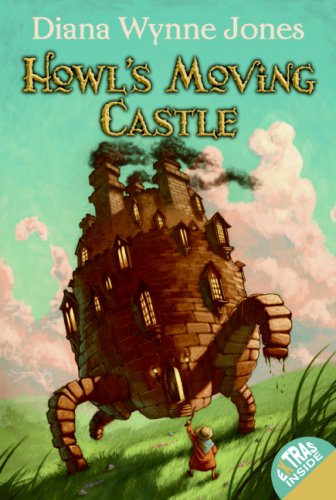
Stuff I Love: Howl's Moving Castle

I’ve decided that every Sunday night, I’m going to post about something that I 100% adore. 

This week, it’s Howl’s Moving Castle. 

I first read Howl’s Moving Castle when I was about 16 years old or so.  I was going through my “I only read CLASSICS” stage; I would sniff disdainfully at my peers who had a Stephen King or a Dean Koontz under their arm, and proclaim the superiority of Elizabethan playwrights. 

I was not a popular kid.

However, I did have a shamefaced secret.  I was a voracious and indiscriminate fantasy reader.  I haunted a used paperback store near my house, and gobbled up all of the dragons, knights and damsels I could get my hands on.  Unfortunately, since I was shopping at a junky used book store, I read a lot of crap.  Sometimes, it seems like any author who can spell dragon thinks they can write a fantasy novel.  Most of these were straight up Tolkien rip-offs.  Some took Star Wars as their guiding text.  Others just novelized the D&D handbook. Objectively, I would say that 85%  of what I read was terrible.

I remember the day I found Howl’s Moving Castle on the shelf.  In my memory, it was shrouded by a golden glow, in a shaft of divine light, but I’m pretty sure that wasn’t the case.  It cost $1.50, which was a whole hour of babysitting for me.  Normally, I only paid $0.25 for my paperbacks; but something told me to blow my budget for this one. 

Friday, March 5, 2010

Missile Mouse: The Star Crusher by Jake Parker


Missile Mouse is a Galactic Security Agent, charged with keeping the universe safe from the Rogue Imperium of Planets. RIP have gotten their hands on a scientist with the ability to create a doomsday device that could destroy whole galaxies. It’s up to Missile Mouse and his new partner, Hyde, to get him back and stop the RIP.


Just from that brief description, this doesn’t sound like the type of book that I would like. It has two elements that I avoid in fiction. First off, there’s talking animals, albeit alien talking animals. Missile Mouse is a mouse (duh!) and his partner appears to be some sort of hairy pig thingy. Plus there are shark men. Talking animals are a big no-no in my book. Next, that doomsday device? It’s a weaponized black hole. So called “hard” sci-fi loves black holes – they go off into innumerable pages of technobabble about the creation and maintenance of these giant suck balls – but plot and characters tend to go bye when a black hole enters the picture.

Despite the presence of two Merideth repellants, I really liked this book. Why? Well, a big part of it is Jake Palmer’s art. Palmer has an animation background, and it shows. His panels are dynamic and full of motion, and the layout is not just a progression of squares. The character designs are witty and imaginative, even those dreaded shark men. Clear, bright colors make this book really pop.

Also, Palmer doesn’t let himself get bogged down in the science part of his sci-fi. This book is really more of a space based adventure that rotates around a missing scientist. The plot is not a new one, and it might even read as trite to savvy readers. However, the fun and energy that Palmer puts into his story is infectious, and tween readers will quickly get into the spirit.

This would be a great choice for a reluctant reader in the 8-12 year old range, but I think it does have some all-ages appeal.  I'm sure Missile Mouse will have more adventures, and I am looking forward to them.

Monday, March 1, 2010

Locke and Key: Welcome to Lovecraft by Joe Hill and Gabriel Rodriguez

I am so far behind the curve with this series, it’s not even funny. Here’s the thing. I’m an enthusiastic consumer of horror novels, but I’m not a big fan of horror comics. It seems strange, but something about the graphic element of a comic book makes everything too… visceral for me. So horror comics often get the short end of the stick when it comes to my reading.

However, I really wish that I had looked at Locke and Key sooner, because it is fantastic.

The Locke children are attempting to recover from the horrific murder of their father; their mom and uncle have moved them across the country to the Keyhouse, in Lovecraft, MA. Bode, the youngest, discovers some amazing secrets about the Keyhouse, and makes friends with a mysterious being living down the well. The being seems friendly, but it has secrets, and has more to do with the Locke family’s troubles than they know.

This book grabs you right from the start and doesn’t stop. Although there is some blood and gore, the book really trades on suspense and fear of the unknown. The Keyhouse is full of mystery, and Hill does a great job of building the suspense. I also really like how he manages to make the Locke kids feel real. Bode in particular seems like a real little kid, and his actions move the book forward. Each has a different way of dealing with the changes in their lives, and each feels authentic.

Art in comics is sometimes just a matter of taste, and Gabriel Rodreguez’s art doesn’t really suit me. It works fine for the story (although I wish he was a little more judicious with his shadowing) I just didn’t care for it. Jay Foto’s colors really work for the story, as they have just the right amount of grey to make everything atmospheric, but not too dark.

I am eagerly awaiting the next volume in this series, and hope that if if they do make a Locke and Key movie, they don’t totally screw it up.