Showing posts with label dystopias. Show all posts

Saturday, October 8, 2011

Review: Blood Red Road by Moira Young

What You Need to Know:  This YA Dystopian is the best contender for the "next Hunger Games" and an amazing book on its own, and one of my Best Books of 2011.

Summary: Saba lives in Silverlake, a small piece of (kind of) sustainable land carved out of the ever shifting dust that has taken over the world.  She lives with her father, broken since the death of her mother, and her baby sister.  Most importantly, she has Lugh, her twin brother and other half, who provides the hope and happiness in her life.  When strange men ride up out of a storm and steal Lugh, killing her Pa, she swears she will find him.  Saba sets off into the wastelands, and runs afoul of those who prey on travelers in the dust.  Literally forced to fight for her survival, Saba discovers her own strengths and feelings she didn't know she had.

What Worked:  Girl/Girl cage fights!  Amazon-like warrior women! Bitchy heroine!  Smug-Jackass love interest!  Quasi-western setting!  This book is practically Merideth-crack.

Young is an outstanding writer, who does an excellent job of creating a sympathetic but imperfect heroine.  Saba is a fighter, but her single-mindedness in getting Lugh back makes her not terribly likable sometimes.    Her devotion is admirable, but maddening.

Young weaves some slight touches of magic-realism into her story, with destinies being written in the stars*, and stones that will lead you to your heart's desire.  These are very subtle, and add another layer of mystery to the book.

I've said it before, the best Dystopian fiction doesn't waste a lot of time telling us how things got this bad.  Young doesn't tell us at all, choosing instead to focus on her story and characters.

And what a story it is.  In addition to the already mentioned cage fights, there's a prison break, giant killer worms, a suicidal raid... lots and lots of action.

What Didn't: This book starts very slowly, and readers may be put off by the unusual patois that Young develops.   Also, the magical elements of the book are an unusual touch for a dystopian adventure, and could be jarring.

Who would I give this book to?  Teen fans of the Hunger Games.  Adults looking for a good example of the dystopian trend.  My brother (seriously, he's very picky).

There be spoilers ahead, so quit now if that sort of thing bothers you.

Wednesday, May 18, 2011

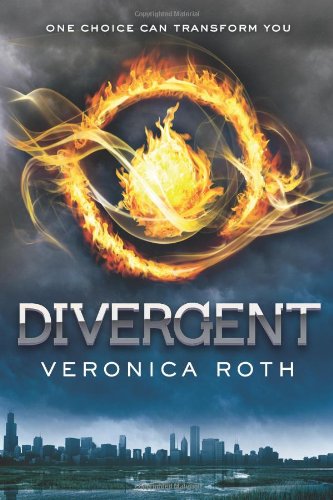
Divergent by Veronica Roth

What You Need to Know: This dystopian sci-fi tale will find an audience with teens seeking the "next" Hunger Games, but doesn't live up to the pre-release hype.  


Summary:  Beatrice lives in a world of factions.  She has been raised as a Abnegation, trained to value selflessness and service.  But as she turns 16, she must choose a faction, which will supersede all else in her life.  Will she remain in Abnegation or choose Candor, who see truthfulness as the greatest good?  Perhaps she will choose Erudite, and become one who seeks knowledge.  Amity values peace above all, and Dauntless, bravery.  A simulation is supposed to reveal where each teen belongs.  Beatrice however, makes a surprising discovery.  She is Divergent, and has qualities of many of the factions.  Divergence is dangerous, and Beatrice must hide her differences while discovering some uncomfortable truths about her society.
 WARNING!  SPOILERS AHOY!

Saturday, April 9, 2011

Books I Didn't Finish: Bumped by Megan McCaffrerty

Total Finished:   78 out of 244 pages.

So, Why Couldn't You Finish It?

In the near future, infertility has struck everyone over the age of 18.  Because of this, teen girls are encouraged to "bump" -- get pregnant.  Recently reuinited 16 year old twins, Melody and Harmony go about this in very different ways.  Harmony, raised on a religious commune, is preparing herself for wife and motherhood.  Melody, raised by hyper-perfectionist parents, has "gone pro" and sold her fertility to the highest bidder.

There is something here -- the idea of teen pregnancy being a desirable state, and the commodification of teen fertility -- these both have great narrative potential.

However,  McCafferty's writing does nothing for me.  The jargon of her dystopia is artificial and cloying, and instead of creating a world, pulled me out of it.  More pressingly, Harmony and Melody are flat out annoying, and not interesting enough to compensate for it.  Throw in a crush on a "perfect" guy by the religious girl, and the refusal of the "perfect" girl to realize that she's crazy about her best friend...  I'm done.

Dissenting opinions?  
Publisher's Weekly
 Good Golly Miss Holly 
Write Meg

Final Word:   Annoying and trite pretty much spells the end of a book for me.  I have too much other stuff to read....

Thursday, March 31, 2011

Wither (Chemical Garden Trilogy #1) by Lauren DeStefano

What You Need to Know:  This is an unique, imperfect, take on the current YA Dystopia trend, that raises some interesting questions about safety and gender.

Summary:  Having been kidnapped, 16 year old Rhine is now a sister wife.  Forced into a polygamous marriage with a wealthy man's son, Rhine does not care about the luxury of her new surroundings.  She only wants to get free and get home to her twin brother in the time she has left.   Like all children, Rhine has only 4 years left to live,  her brother 9.   However, Rhine can't help but care for her "sister wives", her child servants, even (a little) for her husband.  She cares more than a little for Gabriel, a house servant.  Overshadowing those feelings is her father-in-law, a geneticist obessed with finding a way to prolong his son's life.  When Rhine sees the depth of his obsession, she knows she must escape.

What Worked:  This is a very fast moving story.  Wisely, DeStefano doesn't give too much background on the cause of the early deaths, doling that information out as the narrative progresses.  She also doesn't back away from the less savory aspects of a world where young girls are truely commodified.  Rhine is kidnapped while looking for work.  Girls are sold into prostitution or shot if they are not purchased to be wives.   Sister wives are expected to pump out babies, fast. 

Most interestingly, DeStefano shows the effects of a world without adults through the three different sister wives.  The viewpoint character, Rhine, is fairly ordinary, having had a reasonably "normal" life.  Jenna, a street kid, turned to prostitution and looks at her forced marriage as a nice place to die.  Finally, the youngest, Cecily, raised in a orphanage, sees mariage and motherhood as her joyful destiny.  Each of these girls brings their own experinces to their "marriage" and their reactions and choices are believable.

What Didn't:  The world is apparently in a crisis beyond the early mortality rate, but DeStefano doesn't elaborate.  There's some mention of a war, but this is not expanded on.  Also, there is apparently a huge gap between the wealthy and the poor, but again, this is not fully explained.   A little more world building would have made the circumstances clearer. 

The big bad in the story, Rhine's father in law, Housemaster Vaughn, is little more than a shadowy grin and a sense of evil.  We know he's performing genetic experiments, and hear about them, but we don't see or hear them.  He obviously menaces Rhine, but his purpose remains doubtful.

Like all YA dystopias, this one has a love story, but the relationship between Gabriel and Rhine feels very tacked on.  Yes, Rhine is 16 and emotional, and yes, Gabriel seems like a nice guy, but their romance gets in the way of the more interesting aspects of the book. 

Who Would I Give This Book To?  I can see this book having a wide audience, as it plugs into a number of current trends -- dystopias, polygamy, genetics, strong girls.  It's less actiony than the Hunger Games, and less romancy than Twilight, but would probably appeal to both those audiences. 

Also Note:  This book has a really great cover, that plays up a lot of the symbolism of the story. 

Wednesday, February 9, 2011

Books I Didn't Finish: Delirium by Lauren Oliver

Total Page Count:  ~200 of 441 pages

Why Didn't You Finish It?:  This book has a killer concept -- in the future, love is a disease.  At 18 everybody gets a "procedure" that will cure them of Amor Deliria Nervosa.  Of course the procedure robs them of most other emotions and the ability to question the government.

Pretties, The Giver, The Cure, Bar Code Tattoo -- all of these books have covered similar ground.  And done it in less than 441 pages! 

Dissenting opinions? Sure.
The Compulsive Reader
Dreaming in Books
Reading Rants


The Bottom Line: While Oliver writes beautifully, it just takes her too long to get where she's going for me. A skillful world building and a clever concept doesn't make up for pages and pages of a wishy-washy heroine being wishy-washy.

Friday, January 14, 2011

Grace by Elizabeth Scott

Grace has grown up among the People.  The People stand opposed to Keran Berj, and his control over all things, including the land.  The men of the People become Rorys, soldiers who fight Keran Berj's guard, and the women follow them from camp to camp.

Some girls, like Grace, are chosen to become Angels.  The Angels study the ways of those who live in the cities, and of Keran Berj, until they carry their bombs to the cities and die, destroying the enemies of the People with their death.  However, Grace, who had an outland mother, did not die as an Angel should, and now she is running from Berj's guard and a people who wish her dead.  Accompanied by a mysterious boy, she takes a train that will carry her beyond their reach.

While I am not a fan of Elizabeth Scott, I will concede that she knows how to convey a lot of information in a very little amount of space.   This book is exactly 200 pages,  and Scott doesn't waste a lot of time with setup or explanations.   In a way, I feel this is one of the weaknesses of the book, I would have liked a little more background about the People, and Keran Berj's dictatorship.   I would have particularly liked more information about the Angels, who are kept both sheltered and exposed to the outside world.  

Maybe I've read too much dystopian fiction, but nothing about this book felt particularly fresh or original to me.  Many of the major touchstones  in the book -- suicide bombers, children informing on parents, secret police -- felt as thought the were taken from other fiction.  Scott does combine these elements well, but the Orwellian overtones are impossible to ignore.

As for the plot, there wasn't much.  This is very much a character study.  What plot there was was flawed.  I don't think it held together all that well.  The major hole -- how did Grace, a girl of the People, know an underworld contact who could smuggle her out  -- is never addressed.  As most of the book is told in flashback, this bugged me throughout the narrative.  

Kerr, Grace's mysterious companion, has his own backstory, his own reasons for running.   For fear of spoilers, I won't reveal who Kerr is or why he wants to leave, but held up to the light, I'm not sure his story holds up.  

This is a fast read, and teens who are put off by the length of other dystopian stories might enjoy this book.  The lack of plot, and focus on characterization will turn off many reluctant readers.