Before I Fall by Lauren Oliver.
Sam Kingston didn't expect to die. Not on the way home from a party, in a car accident, slightly buzzed from the vodka she and her girls have been shooting. But die she does.
And then she wakes up, on the morning of the day of her death, to live it all over again. And again. And again. Seven times in all, till she learns to put things right.
I'll be honest, I put this book off. Nothing about the premise appealed to me, however, it was considered a Printz contender and was named on the 2011 Best Fiction for Young Adults list. More importantly, some of my co-workers read it, and liked it. So, I dove in.
This book represents an interesting conundrum for me -- how to acknowledge the craft of a book, and talk about it, without liking it. Because, while I admire Oliver's writing and the skill she brought to her story, I had a strong visceral dislike for the book. Mostly because of the main character.
To put it bluntly, Sam is a bitch. The worst kind of mean girl, in my opinion. She's not the instigator of any of the myriad cruelties and taunts that she and her crew hand out, but she always goes along. She's not vile or despicable, just weak. What makes her worse than the alpha girl she slavishly follows, is that she knows what they do is wrong. She occasionally has twinges of remorse, but she manages to drown them in sea of consumerism and alcohol.
I'll freely admit, my perspective is skewed by my experience. Girls like Sam made my life miserable. Girl on girl social aggression gets me all steamed up, and it seems to begin earlier and earlier. While reading Before I Fall I wasn't concerned with if Sam would find redemption, but with how I could keep my daughter from turning into a girl like her, or becoming one of her victims*.
Putting that aside is difficult, and I have to say, my dislike for Sam made it hard for me to engage with the story. However, I can say that Oliver writes beautifully. She manages to take you inside Sam's life, to help you understand how she became what she is. For me, that understanding didn't engender sympathy, but, I can see how it could. The poetic turns of phrase and the small, quiet moments that pepper Sam's struggle are what kept me engaged. Oliver also has a keen understanding of teens, their relationships and how small, random things are what bind friends together.
Since I didn't like Sam, I didn't want to spend much time with her, so for me, this book is overlong. About midway through, I wanted to scream "It's not about YOU!" I'm also not sure that Sam evolved that much through the course of the book; in the end, I still felt like Sam was seeking for herself, not for others as she had claimed. However, with a character like this, you can only expect so much growth.
One of my benchmarks for a successful teen book is: can I imagine the teen I would hand this book too? With Before I Fall this is an easy task. I can totally see teen girls with a taste for romance and melodrama devouring this one. The length might put some readers off, but girls like Sam, or who wish they were, will eat it up.
A teen librarian speaks about books, teen literature, comics, graphic novels and other stuff.
Tuesday, January 18, 2011
Saturday, January 15, 2011
Nothing by Janne Teller
In a small Danish town, a 7th grader stands up and declares "Nothing Matters". He walks out of school, and takes up residence in the plum tree outside his house, shouting and throwing plums at his classmates as they go to and from school.
In order to prove him wrong, the class decides to build a pile of meaning in an old sawmill. All is well, until the classmates start choosing what each will give up. Although the sacrifices start small -- favorite books, special shoes -- they grow and grow to monstrous proportions.
A co-worker recommended this book to me -- no, that's not right. She didn't recommend it, she told me it was amazing, and completely devastating to read. She said it was the best book of 2010, but she would never read it again.
With a pitch like that, how could I resist?
Well, she was right. This is an astounding book, that I will never, ever, ever re-read. Nothing reminds me of The Chocolate War or any number of books by Adam Rapp -- a beautifully crafted, extraordinary novel that makes you want to give it all up and meditate on a cliff, or I suppose, in a plum tree.
When I first started the novel, I wondered about the cold, almost mechanical voice of the narrator Agnes. However, as events unfold, we learn what made Agnes' voice, and it makes perfect sense.
Do I recommend Nothing? No, in fact, I have a hard time envisioning the teen I would hand this book to. But I commend Teller for creating a haunting, extreme yet believable tale that will stay with the reader for a long time.
In order to prove him wrong, the class decides to build a pile of meaning in an old sawmill. All is well, until the classmates start choosing what each will give up. Although the sacrifices start small -- favorite books, special shoes -- they grow and grow to monstrous proportions.
A co-worker recommended this book to me -- no, that's not right. She didn't recommend it, she told me it was amazing, and completely devastating to read. She said it was the best book of 2010, but she would never read it again.
With a pitch like that, how could I resist?
Well, she was right. This is an astounding book, that I will never, ever, ever re-read. Nothing reminds me of The Chocolate War or any number of books by Adam Rapp -- a beautifully crafted, extraordinary novel that makes you want to give it all up and meditate on a cliff, or I suppose, in a plum tree.
When I first started the novel, I wondered about the cold, almost mechanical voice of the narrator Agnes. However, as events unfold, we learn what made Agnes' voice, and it makes perfect sense.
Do I recommend Nothing? No, in fact, I have a hard time envisioning the teen I would hand this book to. But I commend Teller for creating a haunting, extreme yet believable tale that will stay with the reader for a long time.
Friday, January 14, 2011
Grace by Elizabeth Scott
Grace has grown up among the People. The People stand opposed to Keran Berj, and his control over all things, including the land. The men of the People become Rorys, soldiers who fight Keran Berj's guard, and the women follow them from camp to camp.
Some girls, like Grace, are chosen to become Angels. The Angels study the ways of those who live in the cities, and of Keran Berj, until they carry their bombs to the cities and die, destroying the enemies of the People with their death. However, Grace, who had an outland mother, did not die as an Angel should, and now she is running from Berj's guard and a people who wish her dead. Accompanied by a mysterious boy, she takes a train that will carry her beyond their reach.
While I am not a fan of Elizabeth Scott, I will concede that she knows how to convey a lot of information in a very little amount of space. This book is exactly 200 pages, and Scott doesn't waste a lot of time with setup or explanations. In a way, I feel this is one of the weaknesses of the book, I would have liked a little more background about the People, and Keran Berj's dictatorship. I would have particularly liked more information about the Angels, who are kept both sheltered and exposed to the outside world.
Maybe I've read too much dystopian fiction, but nothing about this book felt particularly fresh or original to me. Many of the major touchstones in the book -- suicide bombers, children informing on parents, secret police -- felt as thought the were taken from other fiction. Scott does combine these elements well, but the Orwellian overtones are impossible to ignore.
As for the plot, there wasn't much. This is very much a character study. What plot there was was flawed. I don't think it held together all that well. The major hole -- how did Grace, a girl of the People, know an underworld contact who could smuggle her out -- is never addressed. As most of the book is told in flashback, this bugged me throughout the narrative.
Kerr, Grace's mysterious companion, has his own backstory, his own reasons for running. For fear of spoilers, I won't reveal who Kerr is or why he wants to leave, but held up to the light, I'm not sure his story holds up.
This is a fast read, and teens who are put off by the length of other dystopian stories might enjoy this book. The lack of plot, and focus on characterization will turn off many reluctant readers.
Sunday, January 9, 2011
Hype and the Law of Diminished Expectations
This post started out as a review of Ship Breaker by Paolo Bacigalupi.
In a nutshell: I liked it, it was good. It was fast paced, well-written, did some very tidy world building and had an interesting take on the whole science-fiction dystopia trend in YA Lit.
However, it wasn't great, I had issues with the central conflict, didn't really care about the two main characters and ended awkwardly. Overall, it just didn't rock my world.
That being said, I walked away from Ship Breaker profoundly disapointed, and I've come to realize, the disappointment had nothing to do with the quality of the book, and everything to do with the hoopla around the book.
Ship Breaker is darling of the YA Lit Universe. It's considered a strong contender for the Printz, its been shortlisted for the Cybils. Many bloggers and critics consider it the best YA book of the year.
So, what's wrong with me? Why did it disappoint me so?
I think that this book suffered from what I have coined "The Law of Diminished Expectations."
While I'm still working out the bugs in the theory, it goes something like this: The more an artistic product is hyped, the less impressed with it I will be when I see it/hear it/read it.
With Ship Breaker, I first read about it on Reading Rants back in May 2010, this was shortly after it was released. In the intervening 7 months, you couldn't avoid the praise for this book. So, by the time I finally got my hands on it, I was expecting something transcendent. Something world-moving. A true monkey-touch-the-monolith moment.
And of course, I didn't get it. I got a good, but flawed story. And that's fine. But I also felt let down, and somehow, personally insulted. And, dear reader, that got me thinking.
I don't know if it's our hyperbole rich society, chronic and serial bandwagon jumping, or just the sheer number of opinions available in our plugged in world, but it's become increasingly easy for any artistic product to get drowned in a sea of rhetoric - both positive and negative. This isn't a new observation, but I had never considered how much damage positive buzz could do. A pile-on of fawning reviewers, bloggers and Facebook commenters can negatively skew my perceptions of a book as much as a group of trollish naysayers. Maybe more, as relentless boosterism sets up an expectation that can never be met.
As a professional, I can't unplug myself from the YA Lit-o-sphere, and retire to a lovely cave somewhere with a Diet Coke and form completely uninfluenced opinions. Nor, do I think I want to. It's part of my job to keep a watchful eye on the trends and chatter surrounding my field. Also, I have honestly come to respect and depend on blogs, comment boards and other feedback sources.
But I will have to come up with a way to remain aware of the impact those sources have on me and my opinions, both good, and bad.
In a nutshell: I liked it, it was good. It was fast paced, well-written, did some very tidy world building and had an interesting take on the whole science-fiction dystopia trend in YA Lit.
However, it wasn't great, I had issues with the central conflict, didn't really care about the two main characters and ended awkwardly. Overall, it just didn't rock my world.
That being said, I walked away from Ship Breaker profoundly disapointed, and I've come to realize, the disappointment had nothing to do with the quality of the book, and everything to do with the hoopla around the book.
Ship Breaker is darling of the YA Lit Universe. It's considered a strong contender for the Printz, its been shortlisted for the Cybils. Many bloggers and critics consider it the best YA book of the year.
So, what's wrong with me? Why did it disappoint me so?
I think that this book suffered from what I have coined "The Law of Diminished Expectations."
While I'm still working out the bugs in the theory, it goes something like this: The more an artistic product is hyped, the less impressed with it I will be when I see it/hear it/read it.
With Ship Breaker, I first read about it on Reading Rants back in May 2010, this was shortly after it was released. In the intervening 7 months, you couldn't avoid the praise for this book. So, by the time I finally got my hands on it, I was expecting something transcendent. Something world-moving. A true monkey-touch-the-monolith moment.
And of course, I didn't get it. I got a good, but flawed story. And that's fine. But I also felt let down, and somehow, personally insulted. And, dear reader, that got me thinking.
I don't know if it's our hyperbole rich society, chronic and serial bandwagon jumping, or just the sheer number of opinions available in our plugged in world, but it's become increasingly easy for any artistic product to get drowned in a sea of rhetoric - both positive and negative. This isn't a new observation, but I had never considered how much damage positive buzz could do. A pile-on of fawning reviewers, bloggers and Facebook commenters can negatively skew my perceptions of a book as much as a group of trollish naysayers. Maybe more, as relentless boosterism sets up an expectation that can never be met.
As a professional, I can't unplug myself from the YA Lit-o-sphere, and retire to a lovely cave somewhere with a Diet Coke and form completely uninfluenced opinions. Nor, do I think I want to. It's part of my job to keep a watchful eye on the trends and chatter surrounding my field. Also, I have honestly come to respect and depend on blogs, comment boards and other feedback sources.
But I will have to come up with a way to remain aware of the impact those sources have on me and my opinions, both good, and bad.
Monday, November 8, 2010
Amigurumi -- A new obsession.
So, as part of the big slump. I taught myself to crochet.
I'm sure there's a deep psychological reason for why yarn and knots and loops and patterns appealed to me at this time, but I'm too lazy to get into it.
Let's just say I was a little obsessive about it. Particularly when I discovered amigurumi
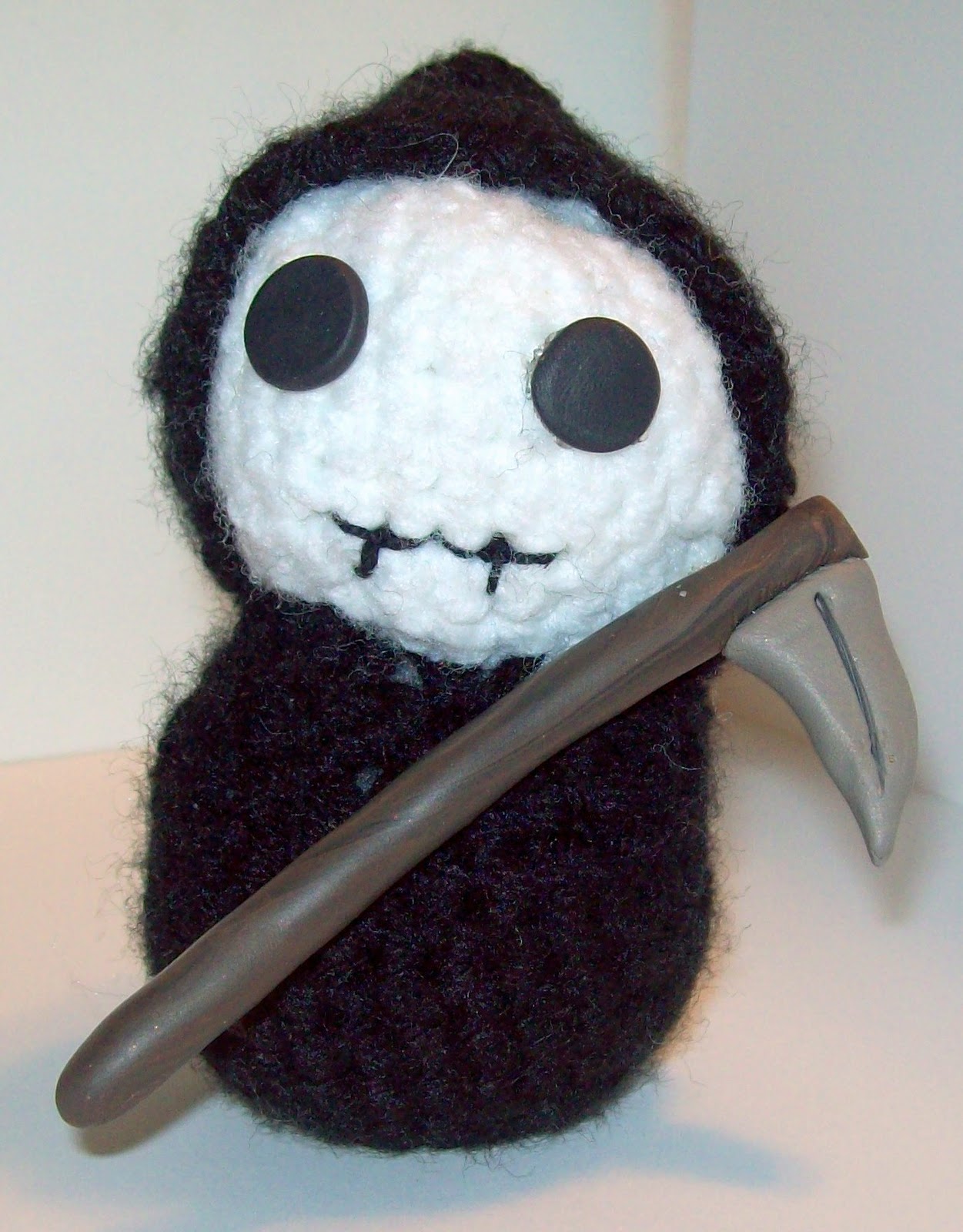
According to Wikipedia, amigurumi is the "is the Japanese art of knitting or crocheting small stuffed animals and anthropomorphic creatures." O.K. All I know is even my cold, black heart melted when faced with the yarn-based cuteness of something like this.
I'm sure there's a deep psychological reason for why yarn and knots and loops and patterns appealed to me at this time, but I'm too lazy to get into it.
Let's just say I was a little obsessive about it. Particularly when I discovered amigurumi
According to Wikipedia, amigurumi is the "is the Japanese art of knitting or crocheting small stuffed animals and anthropomorphic creatures." O.K. All I know is even my cold, black heart melted when faced with the yarn-based cuteness of something like this.
I made him, from a book called Creepy Cute Crochet by Christen Haden (a.k.a. NeedleNoodles). This was my first "real" crochet project, which should tell you something about me.
The thing about amigurumi? It's compulsive. You can't make just one. So I made more. And more. And more. Now, most of them will be leaving my house as holiday gifts, but I have no doubt that I will make more to take their place. I've made zombies, and aliens, and cats and snitches and....
As I complete my little yarn friends, I'll post them here. For no other reason than I think that they're cool.
The Grimm Legacy on Book Obsession
Hey Ya'll --
I have a new post up on the blog from my day job -- http://bookobsessiongpl.blogspot.com, on The Grimm Legacy by Polly Shulman.
There need to be more books about library pages...
I have a new post up on the blog from my day job -- http://bookobsessiongpl.blogspot.com, on The Grimm Legacy by Polly Shulman.
There need to be more books about library pages...
Sunday, November 7, 2010
How I Lost My Sparkle -- or Why I Quit Posting Here.
So, around the middle of August, I sort of quit.
Not just posing on this blog, but lots of things. I quit exercising, I quit watching what I eat, I quit reading anything new, I quit caring how I looked, I just sort of ... quit.
I was coming off a successful, but busy, summer at the library. The popular perception is that summer is a lazy time, but this is not true for Teen librarians. Summer, and the related programming, is when we kick it into high gear. In August, when it all ends, I would typically take a deep breath and look forward.
But this year, I didn't. I couldn't.
My department lost both of it's managers -- the boss and the boss's boss -- within two weeks of each other. We went from being a department of 8 people to a department of 5.5, with no change in workflow or open hours. That meant a lot more responsibility, a lot less down time. Also, you may think you'd get a lot more done without a supervisor, but trust me, you wouldn't. Because without somebody in charge, everything -- and I mean everything -- must be discussed by everybody. Decisions by committee are the worst kind.
Also, my library lost all of it's pages at the start of new fiscal year. Which means that everybody else had to take over shelving and circulation duties. Understand, I don't think that I'm too good to shelve a cart. I worked as a page in college and high school. But, as a degreed professional, it is a little demoralizing. My professional work -- webpage, readers advisory, programming, mentoring, etc. -- built up, whilst I was busy alphabetizing, doing the same minimum wage job I did as a 17 year old.
Adding to my general malaise were some professional bumps. My book was done, but there were delays and rewrites and indexing and ... let's just say the cursed tome didn't go down without a fight. Towards the end, I would have been happy not to look at graphic novels for a long time. I had applied for a promotion within my library, and even though I "knew" snowballs in Hades had longer odds, I still hoped. So when I didn't even get asked to interview, it hurt. It hurt badly enough that I was ready to walk away from libraries entirely.
Writing it out like this, I suppose the malaise that gripped me isn't surprising. Basically, I folded in on myself. I re-read all of Dorothy Sayers. I taught myself to crochet. I unpacked the boxes from our summer move, and taught myself to make some recipes. But as far as reading, or writing, or anything beyond the bare minimum of what was expected of me -- it wasn't happening.
And I survived. I wasn't happy, really, but I wasn't unhappy either. It would be possible to maintain a life like that for a very long time. People kept asking me, "what's wrong" and I would shrug and mumble something non-committal.
My daughter, Miss B, is a big proponent of "sparkle." She means literal sparkle, of course; in her world, every outfit can be improved with sequins, there's no such thing as too many accessories and glitter is always the right answer. But she also means something else. For Miss B. "sparkle" is the creative spark, the sense of adventure, the "muchness" that makes life and work interesting. And one day, she looked at me and said "You've lost your sparkle."
The English language needs a term to describe an epiphany delivered by a 9 year old in combat boots.
She was right, I had lost my sparkle. And I missed it. I missed feeling like there were possibilities beyond what I could see. I missed the sense of infinite possibility that working with teens gives me. I missed finding opportunities to startle or amaze. I missed my sparkle.
So now, today, I start getting it back. And I start with this blog. Watch this space.
Not just posing on this blog, but lots of things. I quit exercising, I quit watching what I eat, I quit reading anything new, I quit caring how I looked, I just sort of ... quit.
I was coming off a successful, but busy, summer at the library. The popular perception is that summer is a lazy time, but this is not true for Teen librarians. Summer, and the related programming, is when we kick it into high gear. In August, when it all ends, I would typically take a deep breath and look forward.
But this year, I didn't. I couldn't.
My department lost both of it's managers -- the boss and the boss's boss -- within two weeks of each other. We went from being a department of 8 people to a department of 5.5, with no change in workflow or open hours. That meant a lot more responsibility, a lot less down time. Also, you may think you'd get a lot more done without a supervisor, but trust me, you wouldn't. Because without somebody in charge, everything -- and I mean everything -- must be discussed by everybody. Decisions by committee are the worst kind.
Also, my library lost all of it's pages at the start of new fiscal year. Which means that everybody else had to take over shelving and circulation duties. Understand, I don't think that I'm too good to shelve a cart. I worked as a page in college and high school. But, as a degreed professional, it is a little demoralizing. My professional work -- webpage, readers advisory, programming, mentoring, etc. -- built up, whilst I was busy alphabetizing, doing the same minimum wage job I did as a 17 year old.
Adding to my general malaise were some professional bumps. My book was done, but there were delays and rewrites and indexing and ... let's just say the cursed tome didn't go down without a fight. Towards the end, I would have been happy not to look at graphic novels for a long time. I had applied for a promotion within my library, and even though I "knew" snowballs in Hades had longer odds, I still hoped. So when I didn't even get asked to interview, it hurt. It hurt badly enough that I was ready to walk away from libraries entirely.
Writing it out like this, I suppose the malaise that gripped me isn't surprising. Basically, I folded in on myself. I re-read all of Dorothy Sayers. I taught myself to crochet. I unpacked the boxes from our summer move, and taught myself to make some recipes. But as far as reading, or writing, or anything beyond the bare minimum of what was expected of me -- it wasn't happening.
And I survived. I wasn't happy, really, but I wasn't unhappy either. It would be possible to maintain a life like that for a very long time. People kept asking me, "what's wrong" and I would shrug and mumble something non-committal.
My daughter, Miss B, is a big proponent of "sparkle." She means literal sparkle, of course; in her world, every outfit can be improved with sequins, there's no such thing as too many accessories and glitter is always the right answer. But she also means something else. For Miss B. "sparkle" is the creative spark, the sense of adventure, the "muchness" that makes life and work interesting. And one day, she looked at me and said "You've lost your sparkle."
The English language needs a term to describe an epiphany delivered by a 9 year old in combat boots.
She was right, I had lost my sparkle. And I missed it. I missed feeling like there were possibilities beyond what I could see. I missed the sense of infinite possibility that working with teens gives me. I missed finding opportunities to startle or amaze. I missed my sparkle.
So now, today, I start getting it back. And I start with this blog. Watch this space.
Subscribe to:
Posts (Atom)